Sophie Adenot's French experiments on the ISS (Epsilon mission)
As part of the Epsilon mission, Sophie Adenot will take part in nearly 200 scientific and technological experiments on the ISS. Some of these will be directly managed by Cadmos (Centre for the Development of Microgravity Activities and Space Operations) in Toulouse. Here is a closer look at the scientific, technological, and educational French experiments.
Physiology and health
EchoFinder: fully autonomous ultrasound scans
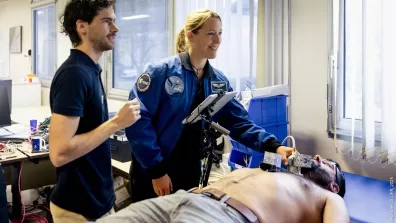
EchoFinder is a high-definition ultrasound scanner capable of operating without guidance from Earth: it will be fully autonomous, employing augmented reality and artificial intelligence. For future crewed missions to the Moon or Mars, the signal latency due to the distance precludes operating a scanner remotely from Earth. Other applications envisioned include at sea, in submarines or to offer solutions for medical deserts. EchoFinder will require two astronauts—a “subject” and an “operator”—to operate it aboard the ISS.
Partners: Caen University Hospital, MEDES space clinic
PhysioTool: keeping a check on astronaut health
PhysioTool aims to keep track of technology advances using synchronized physiological sensors. The experiment will measure a range of parameters to monitor astronauts’ health, such as arterial blood flow, blood pressure, heart rate, temperature, saturation, respiratory rate or sleep. The aim is to develop and validate new physiology instruments designed for activities in weightless conditions, on the ISS or on future crewed missions to the Moon and Mars, to support better monitoring of astronauts’ health.
Partners: Angers University Hospital, University of Lorraine, MEDES space clinic, Artinis, Somnomedics
EchoBones for bone scanning
Bones do not lend themselves well to ultrasound imaging, but there is a technique that can be used to study bone anatomy by measuring bone density and blood flow. With a single instrument, EchoBones will generate ultrasound scans of bone anatomy to assess the structural integrity of bone tissue and quantify blood flow inside them. At this stage, this experiment will be tested by Sophie Adenot on the ground, acquiring readings before and after her flight.
Partners: Angers University Hospital, Delft University of Technology (TU Delft), Inserm
Technology and the future
MultISS: analysing surface bio-contamination
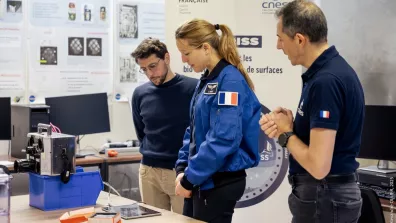
MultISS (Multimodal Multispectral Imaging & Spectroscopy System) is a tool designed to observe and analyse surface bio-contamination aboard the ISS using multispectral and fluorescence analysis. The aim is to prevent biological contaminants taking hold in spacecraft to preserve crew health on future long-duration human spaceflights. Such contamination, like bio-corrosion for example, may also damage life-support systems and other critical equipment.
Partners: Lumetis, COMAT
MatISS-4: clean and innovative surfaces
MatISS-4 is a passive device capable of trapping atmospheric contaminants. This suite of experiments is designed to study how innovative surfaces could stop germs spreading. The materials used were selected for their ability to prevent bacteria from gaining hold, proliferating and creating the biofilms that protect them. MatISS-1 was deployed by Thomas Pesquet on his Proxima mission to supply research scientists with reference data.
Partners: ENS Lyon, COMAT
EuroSuit: a French spacesuit
EuroSuit is a new spacesuit concept devised by CNES that could play a vital role keeping astronauts safe during critical mission phases like launch and landing. Sophie Adenot will be testing out a prototype of the suit on her mission to see how quickly it can be donned and removed in the event of an alert.
Partners: Spartan, Decathlon
Educational experiment
ChlorISS: reap what you sow!
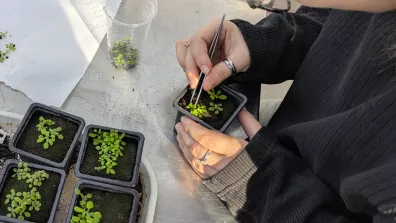
The ChlorISS experiment will be getting thale cress and mizuna seeds to germinate on the ISS and on Earth. It will be performed on the ISS by Sophie Adenot and on the ground in thousands of primary and secondary school classrooms. The aim is to study the influence of gravity and light on both seeds’ growth.
This educational experiment is seeking to get more than 4,000 schools involved in Sophie Adenot’s mission and, more broadly, the French space adventure. Consistent with school life and Earth sciences, physics, chemistry, mathematics and technology curricula, ChlorISS ties in with CNES’s educational policy, which aims to get youngsters interested in space and spark their curiosity to attract them to careers in science and engineering.
Experiments already aboard the ISS
Lumina: measuring radiation on the ISS
Lumina is an optical-fibre dosimeter designed to demonstrate the reliability of this technology for measuring ionizing radiation inside the ISS. This experiment was previously tested during Thomas Pesquet’s Alpha mission in 2021 and is still operating aboard the station. Its aims are to measure and anticipate radiation aboard the ISS. Optical-fibre dosimetry could therefore become a key technology for shielding equipment and crews during space missions to the Moon or Mars.
Partners: Hubert Curien Laboratory (Jean Monnet Saint-Étienne University/CNRS), iXblue, CERN
FoodProcessor: preparing food in microgravity
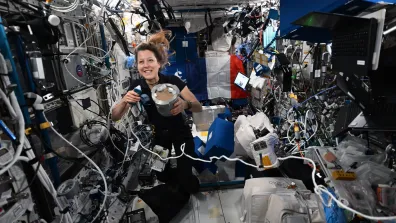
The FoodProcessor experiment could ultimately improve astronauts’ diet on long-duration space exploration missions. Current technologies for preserving pre-prepared meals don’t guarantee sufficient nutritional quality for the five-year conservation period required for this type of mission. Danish astronaut Andreas Mogensen used a first version of the food processor to make chocolate mousse in 2023. Sophie Adenot will be trying another recipe to test new processes in microgravity.
Partners: MEDES space clinic, Inneolab
EveryWear: the astronaut’s personal assistant
EveryWear is a scalable mobile application that allows medical and scientific data to be collected directly using ISS crew members’ iPads and/or from a suite of connected sensors. This experiment was set up aboard the station by Thomas Pesquet in 2017 during his Proxima mission and is still used routinely by crews today. Its purpose is to monitor astronaut nutrition, to conduct physiology surveys and to exchange private messages between the crew and medical teams on the ground.
Partner: MEDES space clinic