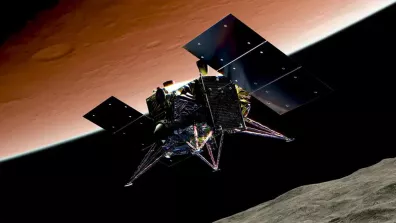


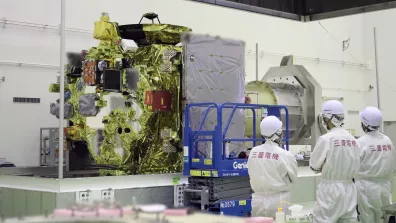
The MMX spacecraft’s arrival at the launch site is a key milestone for this European-Japanese mission, marking the transition from development to the pre-operational phase. With the mission’s departure now fast approaching, everything aboard the spacecraft will be undergoing a final series of checks prior to its planned launch in October from the Japan Aerospace Exploration Agency’s (JAXA) Tanegashima Space Centre.
The MMX mission’s goal is to explore Mars’ moons Phobos and Deimos. The spacecraft will notably be setting out to analyse their composition, gain deeper insights into their origin and bring back samples from Phobos to Earth. Its observations will shed new light on the history of the Martian system and, more broadly, of how its natural satellites formed. The mission also plans to probe the red planet’s atmosphere to characterize the processes driving its changing weather patterns.
Final tests for Idefix® and MIRS
On the French side, the Idefix® rover has been integrated with the spacecraft and is now being put through final functional tests. Electrical testing will be pursued between late May and early June, and the rover will receive a new version of its flight software. More tests are planned in mid-June, including radiofrequency and battery charging tests, a vital step before the mission’s departure.
The MIRS instrument (MMX InfraRed Spectrometer) is pursuing a similar schedule. The spectrometer will be co-aligned with the Japanese cameras between late April and early June, a tricky operation during which it will serve as a reference. Two people from the LIRA astrophysics instrumentation and research laboratory (Observatoire de Paris/PSL) are on site to support these steps. As for the rover, final electrical testing is scheduled between late May and early June to ensure everything is working as planned before launch.
Lastly, the spaceflight dynamics team is continuing preparations for arrival at Mars’ moons. Activities in the months ahead will include finalizing validation of the spacecraft’s trajectories to ensure it gets a clear view of the moons, taking part in exercises to select the rover’s landing site on Phobos and supporting the MIRS and Idefix® teams during mission analysis and ground segment testing (mission ground control and monitoring).
How France is contributing to MMX
🌌 Idefix® set to scout Phobos
Developed jointly by the German space agency DLR and CNES, the Idefix® rover will play a key role in the mission once it sets down on Phobos, exploring the moon’s very-weak-gravity environment and studying its surface properties to provide the science team with invaluable data to plan sample collection.
🔭 MIRS to view the surface of Phobos and Mars in the infrared
The MIRS instrument is an imaging spectrometer that will operate in the near-infrared to analyse Phobos’ surface composition and identify any minerals, water or organic compounds present. Its observations will be vital to gain a clearer picture of the moon’s origin. It will also play a big role in selecting the landing site for the probe and Idefix®, and enable detailed analysis of Mars’ atmosphere.
🛰️ French spaceflight dynamics expertise
France’s contribution to the mission also extends to spaceflight dynamics, a domain where CNES has longstanding expertise. The agency has been involved in validating moon observation scenarios, more particularly in designing two types of trajectories around Phobos, including one of the low orbits in which the probe will fly during Idefix®’s mission.