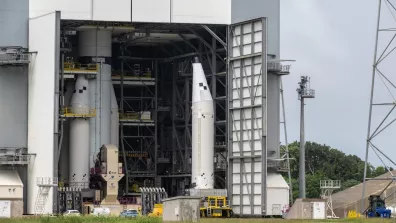
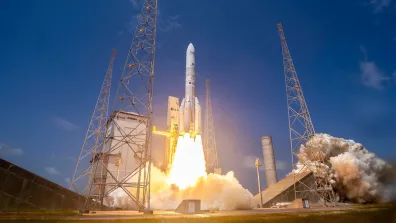
“Ariane 6 was designed from the outset with two complementary variants: the medium-lift A62 and the heavy-lift A64,” says Christian Dubois, launch system engineer at CNES’s space transportation directorate. “The reason for this was to provide extra modularity. We wanted the launcher to be flexible and versatile to take on a broad range of missions for institutional and commercial customers.”
Ariane 64 has four solid rocket boosters, two more than Ariane 62, and a 20-metre fairing (14 metres on A62). “This gives it more thrust off the pad to carry heavier and larger payloads,” points out Christian Dubois.
For its first flight, on 12 February 2026, Ariane 64 demonstrated the full range of its capabilities, orbiting the first 32 satellites of the Amazon LEO high-throughput Internet constellation. A similar mission lifted off this Thursday 30 April.
Replay the launch
Adaptations required
Compared to the A62, the constraints imposed by the A64 are much tighter, as a result of the louder sound levels on launch, the effect on ground facilities of the higher pressure and temperature of exhaust gases from the boosters’ nozzles, and lengthier operations under the mobile gantry. Once in flight, the boosters also interfere more with launcher-to-ground radio links.
Working in close coordination with ESA, ArianeGroup and Arianespace, CNES played a key role in readying the Ariane A64 for this latest flight. The French space agency conducted verification and qualification tasks related to the specific characteristics of the new version and of the special payload of 32 satellites. The heavier upper composite also called for new assembly operations before final assembly in the encapsulation hall.
“We didn’t work directly with the customer, but we were called on to meet their expectations and support optimizations and adaptations at the launch base.”
- Launch system engineer at CNES’s space transportation directorate

Competitiveness gains
With its two launch configurations, Ariane 6 has moved up a gear, broadening its range of potential customers and gaining in competitiveness, vital to ramp up launch rates in a complex international and industrial context. “The aim is to get from four flights in 2025 to seven or eight in 2026, and ten or so a year after that,” says Christian Dubois.
A64 technical characteristics
-
1,500
tonnes of thrust off the pad, against 800 t for A62
-
21.6
tonnes of payload mass into low Earth orbit, against 10.3 t for A62
-
62
metres tall with a 20-metre fairing