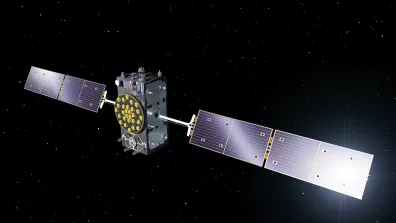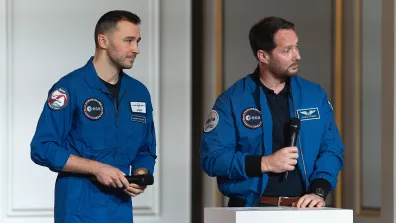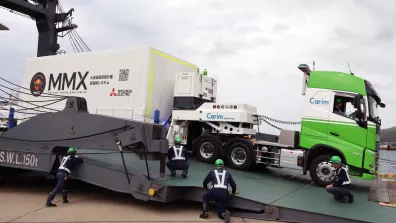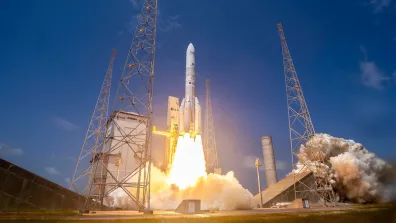


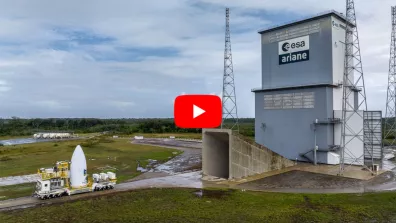
Preparations for Ariane flight VA266 at the Guiana Space Centre (CSG) are in full flow. On 17 December, at 2:01 local time (6:01 CET), Europe’s Ariane 6 heavy-lift launcher will soar skyward from Kourou carrying SAT 33 and SAT 34, two new satellites for the Galileo positioning constellation, the European counterpart of the U.S. GPS. The flight will mark the 14th mission for this first-generation constellation, of which the two satellites are among the last six scheduled for launch between now and 2027.
Medium Earth orbit to ease satellite stationkeeping
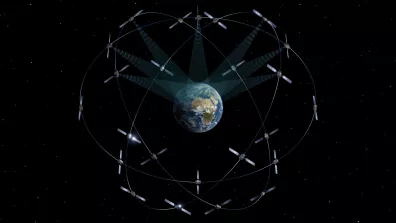
The launcher will inject the pair of satellites into medium Earth orbit (MEO) at an altitude of around 22,922 kilometres. From there, they will make their own way to their operational orbit 300 kilometres higher, chosen because it affords the best trade-off between global coverage, navigation accuracy and energy consumption during launch, positioning and stationkeeping operations. In a lower orbit, more satellites would be needed to achieve the same coverage; and in a higher orbit, signals would take longer to reach the ground, thus reducing accuracy.
More robust Galileo services
The objective of Galileo mission L14 is to make the system more robust and secure the navigation services already operated by the constellation for the future:
- Public Regulated Service (PRS), the secure anti-jamming service for government-authorized users
- Open Service (OS), an unencrypted service for consumer smartphones and other geolocation devices that offers precise positioning, exact timing and reliable synchronization
This will result in an even more reliable positioning, navigation and timing service for billions of civilian users, as well as for maritime, air, road and rail transport, precision agriculture, emergency and rescue services (via Cospas-Sarsat and SAR Galileo), critical infrastructures, logistics, connected objects and autonomous vehicles.
A sovereign navigation system
Galileo is the European satellite navigation programme designed to guarantee Europe’s independence from other global satellite navigation systems like the U.S. GPS, Russia’s GLONASS and China’s Beidou. Funded by the European Union, the system is managed by the EU Agency for the Space Programme (EUSPA).
Its main purpose is to ensure a sovereign European geolocation capability providing high-accuracy services for civil and commercial applications. Galileo thus contributes not only to Europe’s sovereignty and security, but also to sustaining international competition in the strategic domain of satellite navigation.
These new additions to the constellation will consolidate Galileo’s ability to meet growing reliability and accuracy needs. The new Open Service Navigation Message Authentification (OSNMA) entered initial operational service on 24 July this year. OSNMA can be used by all users to verify that the Open Service (OS) signal received on their device is genuine and not spoofed.
The future of the Galileo constellation
The first satellites in the Galileo constellation were launched in 2016. Looking beyond first-generation satellites like SAT 33 and 34 launched at the end of 2025, a second enhanced generation is in development. The aim is to make the system even more robust, through advances in electric propulsion, antennas, anti-jamming, signal and atomic clock accuracy, and inter-satellite links. The end-result will be improved performance, security and flexibility to strengthen Europe’s sovereign geopositioning capability.
Developments between now and 2027:
- launch of last six first-generation satellites (including SAT 33 and 34 in 2025)
- continued upgrading of the constellation to maintain maximum availability
- strengthening of existing services
With these evolutions, Galileo is set to remain a pillar of global navigation for decades to come.
What system is my smartphone using?
You can see in real time which navigation system your smartphone is using. Simply download the GPS Test application for Android phones or GNSS View for Apple phones.
Other applications are also available on the EUSPA website.