

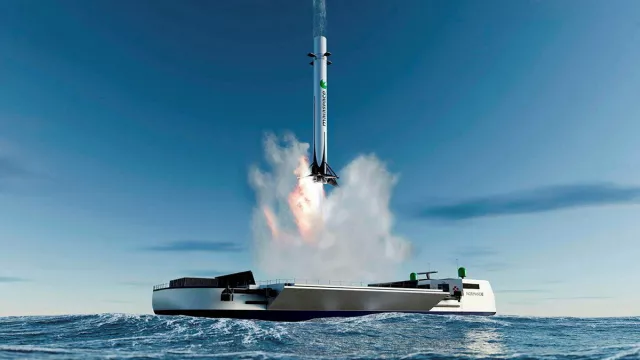
Skyhopper intends to demonstrate first-stage recovery and reuse on a commercial flight of an in-service mini-launcher. ArianeGroup and MaiaSpace have been selected to pursue this project, operating flights from the Guiana Space Centre.
Key information
| Mission | Demonstrate recovery and reuse of a micro-/mini-launcher first stage |
| Domain | Space transportation |
| Start date | 2024 |
| Partners | ArianeGroup, MaiaSpace |
| Where | Vernon, Les Mureaux, La Défense (Paris), Kourou |
| Timeline | 5 years |
| Status | In development |
Key figures
- 3 Prometheus LOX/LCH4 first-stage engines
- 5: Mach number on return trajectory
- 30 metres: height of stage
- -50%: targeted cost saving with respect to Ariane 6
Project in brief
Since 2017, CNES has been working with its partners to further and deploy a roadmap for a reusable launcher first stage through a series of technology demonstrator projects (FROG, CALLISTO, PROMETHEUS, THEMIS) designed to serve as stepping stones towards a final demonstrator between 2026 and 2027.
This roadmap seeks to accelerate the entry into service of a competitive, reusable French mini-launcher operating from the Guiana Space Centre, as set out in CNES’s Objectives and Performance Contract with the government. The pre-operational demonstration riding on an orbital flight will mark the final step in the project, which is being co-funded through the France 2030 investment programme.
The aim is to effectively demonstrate a technology readiness level (TRL) of 7 or 8, corresponding to a pre-operational system, of a recoverable and reusable first stage riding as a passenger on a mini-launcher flight to send a payload into orbit.
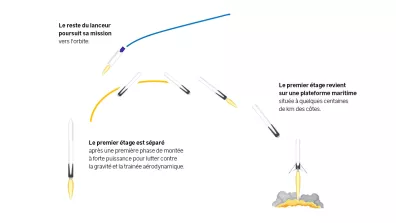
Once the first stage has completed its main mission, it will separate from the second stage at an altitude of about 50 kilometres. It will then re-orient itself, deploy its flight control surfaces and relight its engines to perform a braking burn.
This will be followed by a glide phase during which the stage will fly with its control surfaces, then a final relight and deployment of its landing legs for a vertical landing on a barge a few hundred kilometres off the coast of French Guiana.
The stage will then be secured autonomously by robots and the barge towed back to port. After inspection and refurbishment, it will be mated with another launcher for a new orbital mission, thus accomplishing the demonstration before the end of the decade.
Several test flights could be required to achieve the correct sequencing of all of these complex steps.
CNES's role
Aside from its operating role under the space track of France 2030, overseeing execution of an industrial demonstration procurement under which the prime contractor is also responsible for system aspects, CNES is the contracting authority for this project.
Consequently, CNES is notably in charge of leading milestone reviews for the development of the first stage’s reusability adaptations, based on dedicated engineering analyses to determine its aptitude to accomplish the demonstration. As demonstration flights will be operated from the Guiana Space Centre, The agency is also responsible for range and flight safety.
CNES will also have the opportunity to send experiments as a rideshare on demonstration flights.
CNES contacts
Project leader
Elisa Cliquet Moreno
E-mail: elisa.cliquet at cnes.fr
Head of Access to Space Sub-directorate and subject matter expert
Philippe Pujes
E-mail: philippe.pujes at cnes.fr