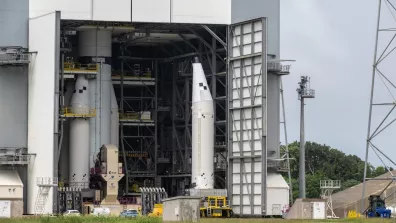
Ariane 6’s sixth flight is no small feat. Thursday 12 February, Europe’s launcher lifted off for the first time in its most powerful A64 configuration. After five successful flights with the lower-thrust A62 variant from the Guiana Space Centre, this launch marks a ramp-up in lift capacity and launch rate, 18 months after its inaugural flight. But what is the rationale for these two variants and how do they differ?
Watch launch
Modularity is the new mantra
Europe has designed Ariane 6 to serve a broad range of institutional and commercial missions. It achieves this through two modular variants based on a common architecture, but optimized for different needs.
- Ariane 62 (A62), the variant that had been operated until this latest launch, has two side-mounted P120C solid rocket boosters that deliver most of the thrust at lift-off. This variant is chiefly designed for government and science missions, with a lift capacity of 4.5 tonnes into geostationary transfer orbit (GTO) and up to 10.3 tonnes into low Earth orbit (LEO). In 2025, it successfully launched its first four commercial missions, following its successful inaugural flight on 9 July 2024.
- Ariane 64 (A64), which flew for the first time this Thursday, has four P120C boosters. It is designed for heavy-lift commercial launches like telecommunications satellites or large constellations, with a lift capacity of 11.5 tonnes into GTO and up to 21.6 tonnes into LEO—more than double that of the A62.
| Features | Ariane 62 (A62) | Ariane 64 (A64) |
| Boosters | 2 | 4 |
| Lift-off mass | 540 tonnes | 870 tonnes |
| Lift-off thrust | 8,400 kilonewtons (kN)* | 15,400 kilonewtons (kN) |
| Lift capacity into LEO | 10.3 tonnes | 21.6 tonnes |
| Lift capacity into GTO | 4.5 tonnes | 11.5 tonnes |
| Main use | Institutional and science missions | Heavy-lift commercial missions, constellations |
* Unit of measurement used in physics to quantify force. One newton is the force required to accelerate a mass of 1 kg at a rate of 1 metre per second squared. One kilonewton is therefore the force required to accelerate a mass of 1,000 kg at this same rate.
-
A64 model in the CNES store
Treat yourself to a superb souvenir of the first A64 flight!

With these two configurations, Ariane 6 is able to adapt to the diversity of demand in the space launch market, while optimizing costs. The A62 is ideal for missions requiring less thrust, while the A64 is tailored to the growing needs of heavy satellite or constellation operators. This first A64 flight was carrying 32 Amazon LEO satellites under its fairing.
Depending on the satellites being launched, each variant can be equipped with a short (14 m) or long (20 m) fairing. As well as being the first four-booster Ariane 6 to fly, the one launched on 12 February from Kourou was also the first with a long fairing. The launcher for this flight, manifested VA267 (for 267th Ariane flight in French), was thus the tallest ever standing at 62 metres, roughly the height of a 20-storey building!
The two variants nevertheless share a number of common elements, such as the main stage with its Vulcain 2.1 engine and the upper stage with its reignitable Vinci engine.
Ramping up power and launch rate
With flight VA267, 2026 heralds a transformative year for Ariane 6. After this dual first (four boosters and a long fairing), Europe’s launcher is set to undergo more changes in the months ahead, with the P160C replacing the P120C to deliver increased performance and capacity for more and heavier satellites.
Meanwhile, Ariane 6 is also readying to ramp up its launch rate. After four successful flights in 2025, operator Arianespace is aiming for seven to eight launches this year from the Guiana Space Centre, combining A62 and A64 flights, and ten in 2027.
CNES’s role in the Ariane 6 project
As the programme’s contracting authority, the European Space Agency (ESA) entrusted the design and integration of the launcher to ArianeGroup, and commercial operations to its subsidiary Arianespace. It appointed CNES as prime contractor to develop ground support equipment in French Guiana, involving construction of a new launch pad and refurbishment of existing facilities.
For flight VA267, CNES conducted verification and qualification of this launch pad in Kourou to meet the specific requirements of the four-booster and long-fairing configuration, and of prepping, assembling and transporting the upper composite of the launcher.
At the Guiana Space Centre, CNES also coordinates each launch and is in charge of range and flight safety to protect people, property, public health and the environment, before, during and after lift-off.