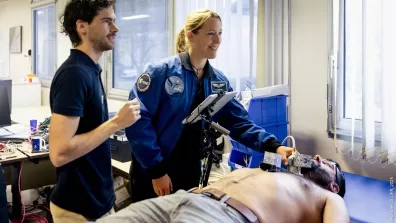
During the course of her mission on the International Space Station (ISS), French astronaut Sophie Adenot will be performing more than 200 experiments. One of these is EchoFinder, a software application that helps the crew do ultrasound scans unaided by an expert. EchoFinder was developed by a joint team of CNES and the MEDES space medicine and physiology institute. “One of its goals was to conceive a practical and even fun-to-use device that enables astronauts to position the scanner probe correctly,” explains Aristée Thévenon, a biomedical engineer at MEDES. In other words, on a fellow crew member’s body.
This isn’t as easy as it sounds. Angling the probe just a few degrees one way or the other can make all the difference between a sharp image and a blurred one. Scanner operators train for years to perfect their technique, but astronauts don’t have time for that.

EchoFinder solves this problem using virtual reality. By moving the probe like a joystick, the astronaut virtually overlays spheres on cubes, on a tablet. It’s like a game of skill: once a sphere is correctly overlaid on the screen, this means the actual probe aboard the station is in perfect position on the subject’s body.
“Our solution also relies on artificial intelligence,” notes Jérôme Daniel, EchoFinder project leader at CNES. “It was developed by our AI expert and trained to recognize organs and take scientifically useable images.”
Sophie Adenot will thus be the first astronaut to use EchoFinder and validate the device. “We’re notably going to ensure that AI correctly handles organ displacement due to weightlessness,” explains Jérôme Daniel.
French expertise monitoring astronaut health
Ultrasound scans are just one of the tools used on the ISS to measure the physiological effects of weightlessness on the human body, such as muscle loss or neurosensory disorders. This is a vast field of investigation for CADMOS, the department in charge of microgravity experiments at CNES.
CADMOS also worked with MEDES to design and develop PhysioTool. “This is an ambulatory device consisting of two small units that attach to the astronaut’s belt,” says Laurent Arnaud, in charge of the experiment at CADMOS. “We can thus monitor a range of physiological parameters around the clock.”
“The data Sophie Adenot collects will be added to those we already have to further our research into physical deconditioning due to microgravity, as we’ll be measuring new parameters like oxygenation of brain and muscle tissues,” adds Cécile Thévenot, human spaceflight engineer at MEDES.

France has extensive experience in monitoring astronaut health. “Since 1982 and French astronaut Jean-Loup Chrétien’s ISS mission,” notes Guillemette Gauquelin-Koch, head of life sciences at CNES. “He tested the first ultrasound scanner in space, so space ultrasound scanning is a French domain of excellence that we’re pursuing with EchoBones.”
EchoBones is the third French physiology experiment on the mission, for which Sophie Adenot will be the subject. EchoBones is a new kind of ultrasound scanner able to see inside bones, revealing their anatomy and blood flows. ”This will give us deeper insight into bone loss due to microgravity,” says Guillemette. “CNES is the first agency in the world to work with an ultrasound scanner of this type.”

Beyond Earth orbit
Experiments developed by CADMOS for the ISS must meet not only meet scientific needs, but also safety and operating requirements. For example, EchoFinder has been developed to work with all types of ultrasound scanners and IT systems, like those planned for the U.S. Artemis programme. “We’re working with the new paradigm of deep space travel,” explains Aristée Thévenon. “Starting with the Moon and then maybe one day Mars. This changes how astronauts will do science and especially medical science aboard spacecraft. They’ll need to be much more autonomous.”
This vision is shared by the team in charge of PhysioTool, as the device incorporates new neuropsychological parameters. “Our device comprises a neurosensory unit,” says Cécile Thévenot. “It’s a sort of video game console with buttons, a joystick and a touchscreen. We developed it with CNES and science teams to stimulate Sophie Adenot’s cognitive capacity, by getting her to follow a target, for example.”
These brain-stimulating exercises will be correlated to physiological readings acquired simultaneously by the device’s other sensors. “We’re increasingly doing integrative physiology, where all the body’s organs are studied together, in a specific emotional and psychological context,” says Guillemette Gauquelin-Koch. “This will help us to envision the future of space exploration.”
“The psychological impact on overall crew health remains a vast field of study,” adds Cécile Thévenot. “The more we learn about that, the better we’ll be able to prepare them for it.”
On the ISS, crews are in direct and constant contact with Earth. That will no longer be the case on the Moon, still less during long voyages to Mars, where all they’ll see through the windows is the darkness of outer space.
- Head of Life Sciences, CNES

Advancing medicine on Earth
In the meantime, these experiments will also benefit us earthlings. Technologies like remotely operable ultrasound scanners are already being used here on the planet, notably to monitor pregnancies in remote regions of French Guiana. “We’re also in talks with the military,” confides Jérôme Daniel. “They’re interested in EchoFinder to equip their submarines, where crews could perform scans unaided.” Engineers are also imagining developments that could serve civil medicine, such as the ability for nurses and general practitioners, or even emergency responders, to perform ultrasound scans.
Research fuelled by Sophie Adenot’s experiments—as well as all those that have preceded and will follow them—also benefits medicine on Earth. Guillemette Gauquelin-Koch notes: “Because they age prematurely in space, astronauts are ideal subjects for studying terrestrial pathologies related to ageing and chronic diseases, so we can track disorders that might affect people who spend all day sitting in an armchair as soon as they appear.” EchoBones, for example, will deliver fresh insights into osteoporosis, which affects the elderly or sportsmen and women with long-term injuries.
Evolving EchoFinder
- No more need for prior readings. Today, readings first have to be recorded for each “patient-astronaut” on the ground to tell the software where organs are located so that the probe can be positioned correctly. The idea is to avert this need, for example using a morphological reconnaissance system.
- Diagnosis. Scans obtained with EchoFinder must be analysed by a scientist or doctor. Another idea is to get AI to detect certain “common” pathologies.
Learn more
-
What is the CADMOS centre preparing and monitoring Sophie Adenot’s experiments?
This CNES structure, based in Toulouse, was created in 1993 to structure human spaceflight activities.