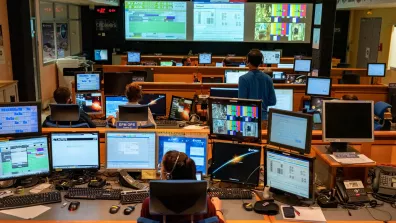

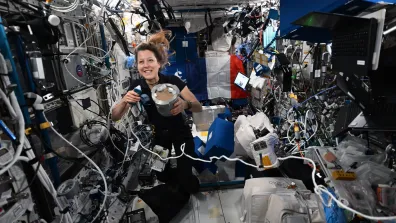
Friday 10 June, 21:00 in Toulouse: Sophie Adenot is finishing her day’s work aboard the International Space Station (ISS) with Food Processor, a French experiment developed by CNES. The French astronaut is being watched live from the control room at the agency’s CADMOS centre for the development of microgravity applications and space operations.
Tickling astronauts’ taste buds
Sophie has a bit of a fright at the start of the experiment, as all the ingredients are to hand and so is the food processor… but where’s the mixing bowl? After searching high and low, she finally lays her hands on it. Things aren’t always where you think they are on the ISS!
Sophie is now all smiles and set to do the experiment. The recipe is a Mediterranean duo of aubergine (eggplant) caviar and hummus. “It smells divine!”
To get the hummus recipe just right, CNES worked with French family firm Andros, which provided its R&D laboratory and its team of chefs. The savoury recipe is a mix of aubergine caviar, a herb sauce and chick pea hummus in which the tahini (sesame paste) has been replaced by peanut butter.
The recipe is a success. But besides putting a smile on the face of her crewmates—it’s no secret that good food is great for morale—the experiment is also pursuing real science goals.
Paving the way for deep-space exploration
The experiment is a prototype food processor designed for the ISS that could ultimately improve a crew’s diet on long-duration space exploration missions.
The experiment’s main aim is to demonstrate the feasibility of preparing food in microgravity. Food Processor could thus enable crews to cook healthy meals that meet their nutritional needs using ingredients produced on Earth or aboard a spacecraft, while managing their food stocks effectively.
The device was used for the first time on the ISS in 2023 by ESA’s Danish astronaut Andreas Mogensen to make a chocolate mousse for the crew. This initial recipe validated the ability to aerate an ingredient on the station to give it a lighter, fluffier consistency. The aim of the Mediterranean duo prepared by Sophie is to use ingredients that one day could be grown on board.

“The idea was to use the food processor already on the station to prepare a savoury recipe. The ability to use ingredients that could one day be grown aboard a spacecraft or inside a base for future exploration missions was crucial in choosing this recipe. That’s why we went for a plant-based recipe combining a vegetable and a legume (pulse).”
- Food Processor experiment lead at MEDES
Now, after the success of Food Processor, a new project is underway at CNES to develop the first prototype of a space kitchen. To accomplish this, CNES has enlisted the support of the MEDES space clinic, COMAT, Groupe Jean Hénaff, Inneolab, Triballat Noyal, Compositic, Innovons à 360 and Andros.