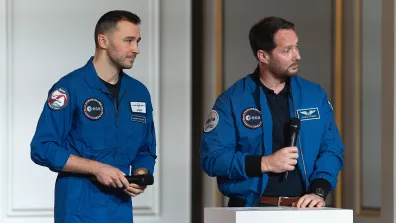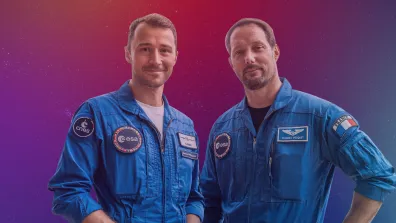
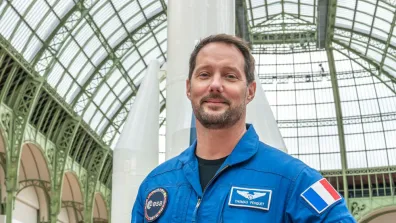
A third mission is on the horizon for French ESA astronaut Thomas Pesquet, who is preparing to return to the International Space Station (ISS). Named Vast-PAM-1, this mission is part of a NASA initiative involving private astronaut missions, following the signing of an agreement between the American company Vast and the French government.
This mission also marks a new milestone in the history of European human spaceflight: for the first time, three ESA astronauts will fly as part of the same crew. Aleš Svoboda, from the Czech Republic, and Adrianos Golemis, from Greece, will fly as ESA project astronauts alongside Thomas Pesquet. For this third space mission, the French astronaut is expected to serve as mission commander.
The three astronauts have already begun their preparations. On the agenda for the coming months, a series of training modules in Europe and the United States.
Intensive training
For Thomas, one of the first major milestones in this preparation phase is a trip to the United States this September. Along with the rest of the crew, he will participate in a training program developed by teams from Vast, SpaceX, and NASA. This program includes theoretical and practical modules, as well as the examination administered by the Multilateral Crew Operations Panel (MCOP) of the International Space Station, whose role is to assess and confirm the qualifications of the three Europeans.
Thomas will then return to Europe, specifically to France, to the Toulouse Space Center. There, he will familiarize himself with the scientific experiments currently under development at Cadmos, an internal CNES unit that develops and monitors experiments conducted in microgravity.
Several refresher training sessions are also scheduled at the European Astronaut Center (EAC) at ESA’s facility in Cologne, Germany.
Scientific experiments and educational activities
CNES, as the French space agency, will determine Thomas Pesquet’s mission program once he is aboard the International Space Station. On the agenda: conducting scientific experiments that meet the needs of the scientific community, as well as educational activities.
Thomas will thus conduct scientific experiments in the fields of physiology, neuroscience, health, and materials physics. These experiments will have been developed by CNES and the MEDES space clinic, a subsidiary of the French space agency based in Toulouse. The astronaut will rely in particular on numerous scientific instruments aboard the ISS, some of which were developed for Sophie Adenot’s current mission: PhysioTool, EchoFinder, MultISS…
In addition to the scientific experiments, the astronaut will also focus on various outreach and educational programs for young audiences developed by CNES. During her previous flight, the “Élève ton blob” experiment was shared with students from more than 2,000 schools. More recently, the ChlorISS experiment conducted by French ESA astronaut Sophie Adenot was followed and replicated by 280,000 students. This is sure to inspire future careers and put stars in the eyes of young and old alike!
Arnaud Prost, another Frenchman who will soon be in space
Along with the announcement of Thomas Pesquet’s new mission came the announcement of the first flight for French ESA astronaut Arnaud Prost. For his first assignment, Arnaud will fly as a flight test engineer aboard the first crewed mission to the private Haven-1 space station, scheduled for launch in 2027.
Following the missions of Thomas Pesquet and Arnaud Prost, France will become the only European country with three active astronauts (along with Sophie Adenot, currently aboard the ISS). Following the Vast-PAM-1 and Haven-1 Crew-1 missions, each astronaut will have a distinct background, skill set, and flight experience—an advantage that will enable France to undertake a wide variety of crewed missions in the future, as the International Space Station is set to be decommissioned around 2030.