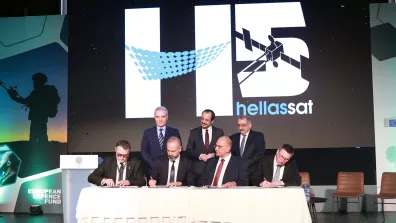
The aim of the partnership agreement signed by France, Greece and Cyprus on 26 February in Cyprus is to supply very-high-performance, very-high-throughput services from geostationary orbit to support faster, more secure and more resilient satellite communications for critical applications. The agreement draws on the SOLiS secure optical space link project developed by CNES and led by Thales Alenia Space under the space track of the France 2030 investment programme. SOLiS aims to demonstrate very-high-throughput free-space optical communications.
Cyprus pilot station
Under this agreement, Thales Alenia Space will supply the SOLiS system and the optical payload to fly aboard the Hellas Sat 5 geostationary telecommunications satellite. Safran will supply the pilot ground station at operator Hellas Sat’s CyOGS teleport in Cyprus. This station will communicate with CNES’s FROGS station already operating at the Côte d’Azur Observatory on France’s Mediterranean coast. This communications system will be designed to be interoperable with other optical communications systems currently in development.


The cooperation agreement was signed during a special ceremony held at the Battlefield Redefined 2026 Conference in Nicosia, an event co-organized with DG DEFIS of the European Commission to mark the Cypriot Presidency of the European Union.
The opportunity to fly and operate the SOLiS system in cooperation with Hellas Sat is a major step towards the adoption of free-space optics for very-high-throughput ground-space communications. The service demonstration carried out under the France 2030 investment programme by Thales Alenia Space, Safran and their SOLiS partners is key to qualifying the first operational applications of this disruptive technology.
- CNES Chief Operating Officer

We’re delighted to be working with Hellas Sat, CNES and Safran to develop this optical communications system, which marks a crucial step towards establishing a secure, very-high-throughput data transmission network. This partnership portends a new era in telecommunications services. By combining multiple wavelengths, the SOLiS system will deliver unmatched performance, approaching one terabit per second.
- Thales Alenia Space Executive VP, Telecommunications

What is free-space optical communication?
Free-space optical communication (FSO), or free-space optics, is an optical communication technology that uses light propagating in free space, i.e., air, outer space, a vacuum or something similar, to transmit data between two points, as opposed to a solid medium like optical fibre, cable or wire.
FSO set to become the gold standard for space communications
Free-space optical communication (FSO) is fast becoming a standard for data transmission in space, offering far superior transmission speeds on the order of one terabit per second compared to a few tens of gigabits per second with current satellite communications systems. This technology is expected to revolutionize space communications infrastructure, in the same way that fibre has transformed communications here on Earth.
The European Commission’s VERTIGO project and CNES’s Co-Op, DYSCO (Démonstration et sYstème SatCom Optique) and now SOLiS projects are focused on research and development, seeking to demonstrate very high-throughput space optical links. These developments aim to show that optical communications technology is a good fit for a range of end-to-end applications, including universal Internet access, direct and permanent data transmission from Earth-observation satellites, private links to data centres and back-up for terrestrial optical fibre in the event of a crisis.
SOLiS, a France 2030 project
SOLiS (Service Optique de Liaisons Spatiales Sécurisées, or secure optical space link service) is a project backed by CNES under the space track of the French government’s France 2030 investment programme. The project aims to demonstrate the technical and economic viability of an optical communications service via geostationary satellites. Thales Alenia Space is leading the SOLiS consortium, composed of large industry primes and mid-tier firms (Safran, Bertin Technologies, Exail, Keopsys by Lumibird), SMEs (Cedrat Technologies, Reuniwatt, OGS Technologies) and French aerospace research centre ONERA. SOLiS harnesses technologies developed through the government-backed Optical Communications (Co-Op) stimulus plan led by CNES and draws on the outcomes of demonstrations delivered for the VERTIGO project funded by the European Commission.
This article is based largely on a Thales Alenia Space press release.