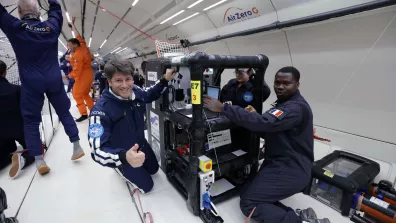
Some of the most promising future advances in medicine are already being made right now on the A310 Zero G operated by CNES’s subsidiary Novespace. Flying at an altitude of 8,500 metres, the aircraft offers passengers a series of 22-second phases in microgravity to conduct tests during parabolic flight campaigns organized by the agency at Mérignac airport, near Bordeaux.
On these campaigns, 10 to 15 scientific experiments are installed inside the aircraft’s cabin, transformed for the occasion into a veritable flying laboratory. Over three days, 93 parabolas are flown, providing a total of more than 30 minutes of weightless conditions during which gravity, the invisible force that governs our bodies from birth, is almost zero.
The 70th flight campaign, held in March this year, is no different. Among the experiments aboard the aircraft, four provide a glimpse—each in their own way—of what the future of medicine might look like, and not just space medicine.
A taste of space
As the contracting authority for parabolic flight campaigns operated by its subsidiary Novespace, CNES selects, funds and coordinates all experiments flown aboard the Airbus A310 Zero G. These campaigns offer real opportunities for researchers and manufacturers to test technologies or study the human body freed from the shackles of gravity, before sending more complex missions into space.
Space-Time: orientation without spatial cues
Adapting to microgravity conditions all starts with the brain—or rather, with what happens when it loses its spatial and temporal bearings. This is the question being addressed by the Space-Time experiment proposed by an international team of researchers from Paris Cité University, Caen University, ULB University (Brussels), UCLouvain University and Aix-Marseille University.
The principle behind the experiment protocol is simple: participants move their hands between two targets at a precise speed. Gradually, the researchers remove audio and visual cues, one by one or both at a time. Without these cues, the brain is forced to reconstruct its sense of space and time relying exclusively on its own internal resources.
The underlying hypothesis of Michele Tagliabue, the experiment’s principal investigator, is that spatial and temporal perception errors are not independent of one another, but stem from the same place in the brain.

If this correlation is confirmed, the results could be significant. First of all in space, where a closer understanding of distorted perception could improve astronaut performance when conducting highly precise tasks; and on Earth, as phenomena observed in microgravity are strangely similar to those experienced by patients with vestibular disorders. Such pathologies—like bilateral vestibular hypofunction (BVH), which affects the inner ear—alter not only a person’s balance, but also their coordination and spatial perception. By altering these functions, microgravity therefore holds promise for gaining a deeper understanding of potential diagnostic and re-education tools.
SAFE: seven campaigns for a plasma
SAFE is another experiment on this 70th flight campaign seeking to generate benefits both in space and on Earth.
The experiment’s aim is to explore the potential of cold plasmas, i.e., partially ionized gases generated at room temperature, as a medical tool in microgravity. These plasmas have the remarkable ability to kill bacteria, including antibiotic-resistant strains, without harming body tissues. This would meet two critical needs on long-duration space missions: disinfecting wounds and helping them to heal with a single compact device.

What really sets SAFE apart is the project’s methodical progression. The programme is unique in its long-term approach: the team leading the project at the GREMI ionized media energetics laboratory (CNRS/University of Orléans) is conducting its seventh consecutive flight campaign on the Airbus A310 Zero G this spring. The first was designed to see if the plasma worked in weightlessness. Subsequent flights introduced biological targets, refined settings, guided the plasma in tubes and then set it in motion over biological surfaces to replicate the care professional’s moves. Each flight has added a new building block to the edifice, bringing the experimental device progressively closer to a tool that could be used in real life.
For this 70th flight campaign, the project will be accomplishing a new milestone: after demonstrating the plasma’s effectiveness against bacteria, the team is going to be looking at how it interacts with skin cells. The results from previous campaigns are already supporting clinical work at Orléans University Hospital, where patient trials are in preparation.
And all this work is paying off: the SAFE team was recently distinguished with the CNRS Cristal collectif award in 2025 for its results and long-term science approach pursued by multidisciplinary teams.
IRIS: high-flying surgery
Midway between Earth and Mars, signals take 20 to 40 minutes to reach their destination. So if a health issue arises, it won’t be possible to consult a doctor over a video link. Besides any equipment on board the spacecraft, the crew will have only their own skills and hands to rely on. This is the kind of scenario the IRIS project (Interventional Radiology In Space), led by the French Radiology Society (SFR) in partnership with CNES and the MEDES space medicine and physiology institute, is aiming to anticipate.
During this flight campaign, a team of interventional radiologists—including Dr Éva Fourage, Pr Vincent Vidal, Dr Jérôme Soussan and Pr Julien Frandon—tested the use of urethral drainage to treat renal colic (kidney stones) with symptoms of infection. Without gravity, even the most routine gestures have to be completely rethought, because fluids don’t flow in the right direction, instruments float and each movement has to be closely choreographed. Checking that such procedures could be learned by non-specialists is an added challenge, but it could prove precious for a crew without an interventional radiologist in its ranks.
The results are encouraging and hold promise for space medicine capable of performing mini-invasive procedures with a compact device in extreme conditions. And like its SAFE and Space-Time counterparts, the experiment is not developing separate solutions only for use in space or on Earth, but rather building expertise that applies to both at the same time.
IURS-3: intubating in microgravity
The IURS-3 experiment aimed to understand how to perform an intubation—a critical procedure in the event of a respiratory emergency—in microgravity, where we lose all our usual bearings and patients and operators are floating in weightlessness. During flights, teams were exposed 31 times to 22 seconds of microgravity during which they had to complete the procedure on specialist mannequins (affectionately named Billy and Bob, after the nickname of French astronaut Jean-François Clervoy).
This tightly choreographed protocol enabled different approaches to be tested in real-life conditions, providing accelerated training for non-specialist operators, comparing innovative devices (assisted guidance, robotics and artificial intelligence) and adapting stabilization methods.

The microgravity conditions—impossible to replicate faithfully on the ground—helped to identify real difficulties and the most robust solutions in extreme conditions. The expected results will inform the design of medical kits for future deep-space missions, while also affording direct applications here on Earth, notably for emergency medicine in remote places or pre-hospital and military contexts.