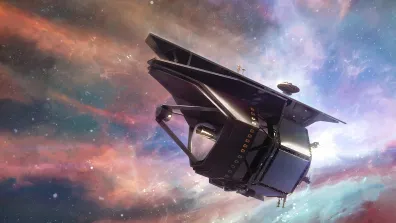


IASI (Infrared Atmospheric Sounding Interferometer) turned 20 this October. In 2006, the Metop-A weather satellite carrying the first instrument was sent into orbit by a Soyuz launcher. Since then, it has been joined by two more satellites—Metop-B in 2012 and Metop-C in 2018—, so there have been up to three IASI instruments operating 800 kilometres above Earth at the same time.
This 20-year milestone is a genuine success, as IASI is contributing a great deal to society. It has massively improved weather forecasting and taught us a lot about atmospheric pollution and climate change.
- Meteorology subject matter expert, CNES
Swiss Army knife of atmospheric sciences
Developed jointly by CNES and Eumetsat, the European operational weather satellite agency, the instrument sounds Earth’s atmosphere twice daily. IASI is an interferometer, i.e., it generates spectra of infrared radiation emitted by reflected sunlight to reveal the atmosphere’s composition.
“IASI is the Swiss Army knife of atmospheric sciences, capable of sensing dozens of physical atmospheric components and variables,” points out Cyril Crevoisier, science lead at the LMD dynamic meteorology research laboratory. These include temperature, humidity, cloud cover, ozone, and carbon dioxide and monoxide.
The instrument was designed to meet the requirements of Europe’s operational weather forecasting programme initiated in 1998, with the goal of guaranteeing sovereign access to highly accurate data for European weather services.
“Observations from space make up a large portion of the data used in weather models,” explains Adrien Deschamps. “IASI has become vital to all European and even world weather services, particularly with the uncertain diplomatic relations now transpiring with major powers like the United States.”


Crucial data for the world’s weather services
Global and local weather models rely on measurements from weather stations on Earth, from sensors on ships or buoys, and on satellite data.
“The national weather service Meteo France uses data from 30 or so space missions in its models,” explains Cyril Crevoisier. “IASI is the prime instrument: without it, forecasts would be much less accurate.”
IASI supplies nearly half of the data that go into Meteo France’s ARPEGE global model and 27% for its AROME regional model. The instrument provides vital information to weather services on atmospheric temperature and humidity, at different altitudes. One of IASI’s strengths is its ability to acquire and deliver data in near-real time.
“This is very important for weather services, which refresh their models very regularly,” explains Adrien Deschamps. “CNES has developed data processing software that Eumetsat relies on to deliver final products to weather services in under 15 minutes.
While IASI is a flagship mission for Europe, in addition to fulfilling its operational weather forecasting objectives the instrument is also acquiring unexpected bonus data. “The original specifications were already really ambitious, yet IASI has even exceeded them,” underlines Gilles Codou, operations project leader at CNES.
Adrien Deschamps adds: “We suspected the data might serve other applications, but not to the extent that they have. IASI has proved to be a sentinel for surveying atmospheric pollution: carbon monoxide, sulphur dioxide, ammonia, etc. It can detect 30 different gases in the atmosphere.
IASI has enabled the first global estimation of ammonia concentrations in the atmosphere, while also identifying the main emission sources. This is a major result and ammonia concentrations are the most downloaded dataset today.
- Science lead, LMD dynamic meteorology research laboratory
Ammonia is mostly released into the atmosphere by crop and livestock farming, with a deleterious effect on air quality. Satellites revealed to what extent during Covid-19: while vehicle traffic was virtually nil during this period, a pollution peak was detected in the Paris area. In Canada, authorities discovered thanks to IASI that raging wildfires were causing peaks of carbon monoxide pollution as far afield as Europe.


Gold standard for spaceborne infrared sounders
You might think that CNES’s experts are keen to praise IASI’s qualities out of pride, but its level of performance is so outstanding that it has come to be seen as the gold standard for infrared sounders. That was the verdict of a panel of international experts 10 years ago, recognizing its unmatched accuracy and stability. All similar spaceborne instruments have subsequently used IASI as the yardstick for the quality of their measurements.
At our technical expertise centre, we monitor the IASI instrument’s in-flight performance daily. That’s how we’re able to assure such data stability and continuity.
- Operations project leader, CNES
And this great stability has made IASI vital to a group of experts in particular: climatologists.
“In the 2000s, IASI helped to develop a new awareness of climate change and today it’s one of the main satellite missions tracking our climate,” explains Cyril Crevoisier. “The stability of the data it has acquired over 20 years is quite remarkable, and such long-term monitoring of climate variables is key in characterizing the climate change we’re now seeing.”
The world’s experts all concur on the importance of monitoring 16 essential atmospheric variables to characterize Earth’s climate, including temperature, humidity, greenhouse gases, ozone, aerosols and clouds. “Put simply, IASI is gathering data on all of these essential climate variables,” notes Cyril Crevoisier.


The technological legacy that made IASI-NG possible
Today, after 20 years of loyal service, IASI is handing over to IASI-NG, a new generation of instruments developed by CNES and Airbus for Eumetsat already flying on Metop-SG A1 launched in August 2025, and slated to fly on Metop-SG A2 and A3 in 2032 and 2039. It’s taking over the missions of IASI while improving its spectral resolution and signal to deliver even more precise measurements than before. “IASI-NG illustrates the technological legacy of the IASI mission: it was the first infrared sounder developed in Europe, and its undisputed success has enabled the development of IASI-NG by the French sector of excellence driven by CNES, manufacturers and research laboratories,” notes Adrien Deschamps.
IASI’s mission is planned to end in 2034, nearly 30 years after it first arrived in orbit. And according to Adrien Deschamps, its successor looks set to make just as big an impact: “IASI-NG is one of the foundational programmes underpinning CNES’s Earth-observation strategy. It promises to enhance operational weather forecasting and above all to extend the long-term data record essential for climate research.”
By the numbers
-
800
More than 800 research papers published
-
50
Nearly 50% of data fed into Meteo France’s ARPEGE global weather model
-
1
The world’s number one spaceborne infrared sounder
A major scientific legacy
The IASI mission delivers key data for climate research, atmospheric science and meteorology, as well as on volcano eruptions. It has built a major scientific legacy, with more than 800 research papers published in scientific journals to date. Most of them concern discoveries about the atmosphere’s composition, followed closely by scientific advances in meteorology and climate. And many of these discoveries have been made by French scientists, who make up the majority of IASI data users.