

End June, PHARAO—the French acronym for Projet d'Horloge A Refroidissement d'Atomes en Orbite (orbital cold-atom clock project)—passed a key milestone when CNES’s mission team signed off the instrument’s in-orbit commissioning. This means the clock’s test and checkout phase is now complete. The French cold-atom clock, attached to the outside of the Columbus module on the International Space Station (ISS), is the main instrument of the European Space Agency’s ACES mission (Atomic Clock Ensemble in Space). It is now fully operational and currently the best space clock in the world.
To achieve the milestone and this degree of accuracy, teams on the ground in Toulouse spent six months fine-tuning the clock and eight more months doing comparisons with clocks here on Earth. A few remaining adjustments are needed on ACES, but PHARAO project operations manager Benoît Léger is confident.
Teams at CNES and partner contractors have done a fine job. This instrument is the most precise clock ever sent into space. And it’s in optimal operating condition, which is a tribute to French prowess.
- PHARAO operations project leader, CNES
An instrument to fathom relativity
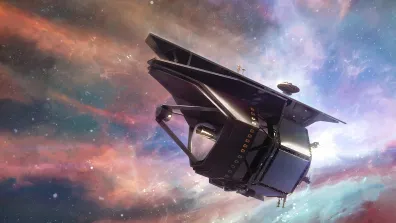
Launched in April 2025 and installed outside the ISS, Europe’s ACES mission aims to test with unprecedented precision a surprising prediction of Albert Einstein’s theory of general relativity: that an object’s mass alters the flow of time in its vicinity. The closer you are to this mass, the slower time passes—a phenomenon that scientists call gravitational redshift.
PHARAO is so precise—to the 16th decimal point—that it can detect a change in the flow of time for a change in altitude of just one metre. By comparing PHARAO, flying in space 450 kilometres above our heads, with clocks on the ground, scientists can test this effect of general relativity with unequalled accuracy.
Testing in microgravity
It is at CNES’s field centre in Toulouse that all operations for ACES, PHARAO and all the ground stations supporting microwave and laser links with the ISS are conducted. And it was from here, on 30 April 2025, that the French atomic clock was powered up in space for the very first time.
Teams began by putting all of PHARAO’s subsystems through their paces. On 14 May 2025, the clock delivered its first Ramsey fringes (see below), the sign that it was in perfect working condition.

They then conducted a long series of fine-tuning and adjustments to find the optimal orbital settings for PHARAO.
A specific feature of PHARAO’s design is that we can only test its performance fully in microgravity. Weightlessness allows us to manipulate cold atoms in ways not possible on the ground. So we can explore operating regimes that have never been studied before.
- PHARAO system engineer, CNES
Time measured by PHARAO was then compared to that measured by ground clocks. This phase ran from November 2025 to June 2026 to achieve the degree of precision required for this milestone. “During this phase, we accumulated data that helped us to assess the clock’s performance and the mission’s science goals,” notes François-Xavier Esnault.
Space is full of surprises
Not everything went according to plan, however, as there were some hitches with other components of ACES. In particular, the Space Hydrogen Maser (SHM), the other atomic clock on ACES, didn’t respond after launch. Not being able to rely on SHM made assessing PHARAO’s in-flight performance longer and more complicated.
“Space projects rarely go exactly as planned once in orbit,” says Benoît Léger. “But the fascinating thing is that even if the satellite—or in this case an instrument—isn’t responding, the science and engineering teams on the ground always find a way forward!”
After several months of probing and testing, the ACES team was finally rewarded for its efforts when SHM sent back its first signal from orbit in the middle of winter.
I was in the control room that day. We were running a new test on SHM when all of a sudden we got an atom signal! We had to check the telemetry three times before realizing, then we all jumped for joy. Everyone was absolutely ecstatic! We’d been trying different things for 10 months and we were all beginning to lose hope.
- ACES operations manager at CNES’s contractor Telespazio
Subsequent analyses have gradually got to the root of the problem and teams were recently able to bring SHM back on stream in support of PHARAO.
The next milestone will be the final in-orbit checkout review for ACES, marking the transition to full operations. “That means all of the mission’s main elements are fully functional and operational,” says Benoît Léger.
Clocks in space, timekeepers on the ground
Since ACES is attached to the outside of the ISS, you might think the crew—like French astronaut Sophie Adenot recently—–have a hand in operating its instruments. But you would be wrong. All operations are conducted from Earth, more specifically by CNES in Toulouse. There was even no need for an extravehicular activity to install ACES, as this task was accomplished by the station’s Canadian robotic arm. All the crew had to do was press ON to power up the clocks.