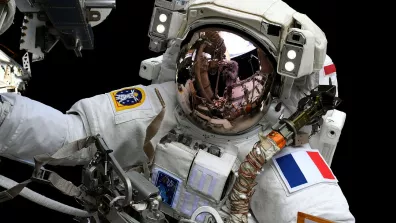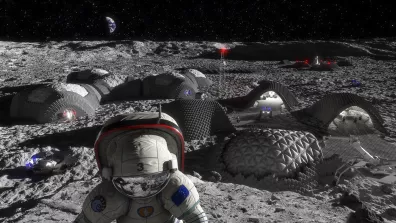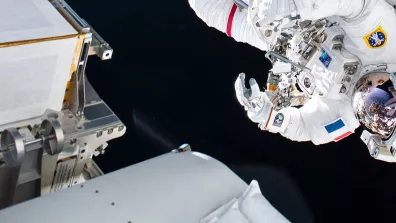

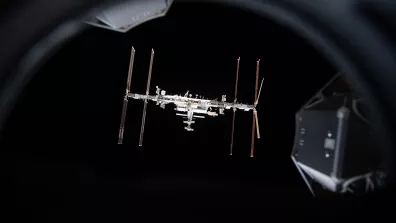
Circling Earth at an altitude of 400 kilometres, the International Space Station (ISS) is a laboratory in a class of its own. In space, it offers astronauts and scientists from all nations an unparalleled Earth and astronomy observatory, and a platform for performing microgravity experiments and paving the way for future crewed exploration missions.
A giant Meccano model in space
The ISS was developed by NASA in partnership with the European Space Agency (ESA), the Canadian Space Agency (CSA) and the Japan Aerospace Exploration Agency (JAXA) for the Western elements, and by the Russian space agency Roscosmos for the Russian elements. The project was designed to replace the ageing Russian Mir space station, finally abandoned and destroyed in 2001. But it would take 13 years, from 1998 to 2011, to assemble all of its elements one by one. And in 2021, the Russians added the Nauka module that would subsequently accommodate the European Robotic Arm (ERA).
The station comprises:
- Pressurized modules where the crew live and work: laboratories, docking modules, nodes (interconnecting elements), airlock and multipurpose modules
- Unpressurized modules providing power, temperature control, storage space for scientific experiments and spare parts, maintenance (robotic arm, etc.)
The ISS is today occupied by a permanent crew of six or seven astronauts from different nations. During their sojourns in space, they conduct scientific and technical experiments, and maintain the station—a fine example of successful international cooperation.
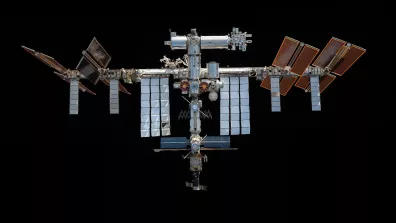
ISS by the numbers
| Altitude | 400,000 m (400 km) |
| Length | 110 m |
| Width | 74 m |
| Height | 30 m |
| Habitable volume | 400 m3 |
| Solar panel surface area | 2,500 m² |
A laboratory in weightlessness
The ISS is a unique laboratory for performing scientific experiments in weightlessness. Gravity affects virtually everything we do here on Earth, so removing gravity—or rather its effects—enables us to observe physical and biological phenomena, material behaviour and other things that would otherwise be masked. The station crew also contribute to physiological research by recording the effects of microgravity on the human body. Muscle loss, vision impairment and bone loss are notably closely monitored. These data serve both medicine on Earth and preparation of future crewed missions, for which astronauts also train to live and work autonomously in unfamiliar conditions.
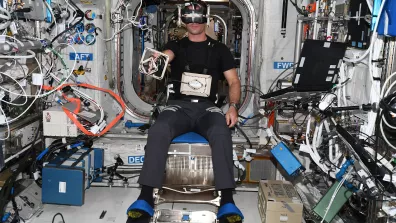
International crew
Americans, Europeans, Canadians, Japanese and Russians regularly work together on the ISS, and astronauts from other nations are sometimes invited aboard. The station accommodates a permanent crew of seven, and more during crew handovers. The Russians manage and occupy their own modules separately. The four Western partners are allocated astronaut “seats” and time in proportion to their investment in the station. NASA gets 76.6% of this time and ESA 8.3%, which equates to roughly one flight per year for a European astronaut. Sometimes the station hosts astronauts and experiments from other nations. Crews are rotated every six months and regularly exchange the roles of commander or engineer. Claudie Haigneré, Europe’s first female astronaut on an ISS crew in 2001, was first flight engineer. In 2021, Thomas Pesquet was the first French astronaut to command the station. In 2026, Sophie Adenot becomes the second French woman on the ISS with her nine-month Epsilon mission, where she serves as mission specialist.
Observing Earth and space
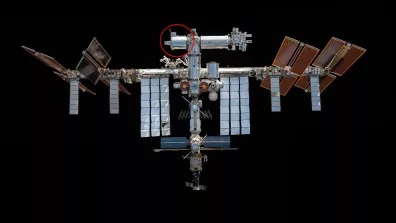
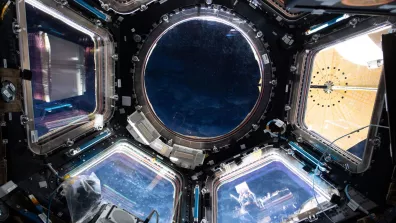
Astronauts regularly come to the Cupola viewing gallery to admire our planet through its seven windows. The ISS offers a unique vantage point for observing variations in glaciers, croplands and cities, complementing satellite imagery. Outside the station, sensors also measure parameters like the gases in Earth’s atmosphere or luminous events above storms.
Where now for the ISS?
The ISS is scheduled to be decommissioned in 2030. But what then? Parts of the station could be disassembled and de-orbited. Private players have expressed an interest in keeping and operating some of its modules, but future research will in all likelihood be conducted on new space stations, some private, some national. For example, Russia is considering building a new station in a different orbit.
Quizz
How many times does the ISS crew see the Sun rise and set every 24 hours?