In conversation with...
- Magali Bouyssou, instrument operations manager at CNES
- Olivier Gasnault, planetologist, co-investigator at IRAP
- Agnès Cousin, geologist and astronomer, science lead at IRAP
The three of you witnessed the moment when Perseverance arrived on Mars in February 2021. What memories do you have of that moment?
Magali Bouyssou: For us, as operators, it was both unexpected and magical. The rover landed in an area of virtually flat terrain, so we were able to directly test SuperCam’s five technologies and start doing science immediately.
Agnès Cousin: For the first three months after the landing, there was a real buzz, because every day we were testing a new function of the instrument and awaiting its data with bated breath. The first LIBS red laser spectrum, the first VISIR infrared spectrum, the first green Raman spectrum and the first sound from the microphone were all special in their own way, and we were apprehensive for different reasons. We were familiar with the LIBS technology used on the ChemCam instrument operating on the Curiosity rover since 2012. But nobody had ever operated a microphone on Mars, for example. Would ours work? Would we be able to open and read the data?

What main discoveries have been made?
Agnès Cousin: We acquired our first measurements as soon as we started testing the camera. SuperCam confirmed that one of the rock outcrops, named Kodiak, two kilometres away on the edge of the delta, was an eroded remnant of the delta fan, meaning that a lake was once present in Jezero Crater, a closed lake larger than its current surface area where water levels must have varied with the flow of the river feeding it.
Olivier Gasnault: SuperCam also quickly identified several lava flows to explore. Volcanism is a focus of study for us, as it’s found on all planets. Much later in the mission, in 2024, we detected carbonates, i.e. carbon-rich minerals, in rocks containing olivines on the edge of the delta. These carbonates are the result of alterations in rock outcrops due to interactions between water and carbon dioxide in the atmosphere, suggesting that conditions might once have existed to support life.
Agnès Cousin: In February 2025, another observation brought new insights into Mars’ hydrology. On arriving at the crater rim, we were able to analyse silicate-rich rocks using SuperCam’s full suite of technologies, including the Raman spectrometer, to retrace their history. We believe these rocks formed from the circulation of hydrothermal fluids at varying depths in which dissolved silica was transported. This silica was later precipitated as a result of environmental changes like pressure and temperature variations. And lastly, also in 2025, the microphone recorded a sound revealing electrical discharges (sparks) generated by grains rubbing against each other as they swirled inside a dust devil.
Olivier Gasnault: These new data will tell us more about Mars’ atmospheric chemistry, as we know for example that such electrical discharges can trigger or accelerate reactions between chemical elements in the atmosphere.


“Mars 2020 is an exciting and motivating mission, because we’re working on an exceptional object of study, the planet Mars, and because it’s a real team effort in exceptional conditions.”
- SuperCam instrument manager, CNES

How do you reconcile science goals with engineering constraints?
Olivier Gasnault: Every day, the mission team tells us how many hours or minutes will be dedicated to science observations, and how much power and data we have available. Working from there, the engineering and science teams operating Perseverance’s instruments get together to decide which ones will be used to secure the best science return. We’re always looking to get the most out of SuperCam’s five sensing technologies.
Magali Bouyssou: Engineering teams also work on technical trade-offs. Sometimes, if a rock is too close to the rover or in the path of the Sun, we might have to veto an operation to mitigate risks. But if an opportunity arises, we do our utmost to adapt. When we discovered Cheyava Falls, a rock likely to contain traces of fossil microbes, we were all together at JPL’s operations centre in Pasadena. The rock was up on the big screen and all of the scientists were buzzing. At times like that, our motivation is increased tenfold and we try to deploy all of SuperCam’s technologies to make new discoveries.
“We’re lucky to have a team at CNES that’s really in tune with the mission’s science goals.”
- Planetologist at IRAP, SuperCam co-investigator


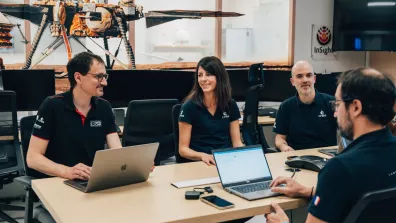
You operate SuperCam together at CNES’s Mars operations centre in Toulouse. Is working in close proximity like this an important factor?
Agnès Cousin: Working together at CNES is a source of strength. The engineers also pay close attention to making sure that all contributors outside the agency, scientists elsewhere in France and U.S. teams aren’t left out. One of the lessons we’ve learned from this mission comes from the teamwork accomplished in really unique conditions [operations are conducted in France and in the United States, late in the day and sometimes at night]. It forces us to maintain perspective and be open to different working methods.
Olivier Gasnault: At CNES, we’re inside our bubble focused on Mars. The tight constraints we have to work with have forged a close community where we’ve learned to talk to each other and stay flexible, which is what makes the SuperCam team so strong. We also owe a debt to the teams that worked before us on ChemCam and on the operations centre. From the outset, they succeeded in creating a brotherhood between our research laboratory and CNES, between France and the United States, and between engineering and science teams.
Key figures
-
500,000
More than 500,000 laser shots, i.e., almost a new target on Mars every day.
-
33
33 samples collected: 10 deposited at the foot of the delta, 23 cached inside the rover.
Learn more
-
Mars 2020 / Perseverance / SuperCam in our project library
Launched in 2020, the Perseverance rover landed on Mars in February 2021 within Jezero Crater, a site selected for its remarkable geological diversity. Equipped with seven scientific instruments, it studies the composition of Martian rocks and soil while also exploring the planet’s atmosphere.